Arakkuparamba Ardhanariswara temple, located at Velingode – Arakkuparamba near Perinthalmanna in Malappuram district, Kerala, is unique in many different ways. Firstly, it is a rare temple dedicated to Ardhanarishvara form (half man half woman) of Shiva. Secondly, the pradakshina path and main sanctum of the temple is always filled with water. Thirdly, the murti is swayambhu and is in such a way that two shilas (granite stones) are fused together (male and female).
The belief is that the temple is located in the spot where a Yogi had darshan of Shiva and Goddess Parvati together. It is believed that they appeared before the Yogi in the Ardhanarishvara form. The name 'Velingode' is believed to have originated from this "revelation" (Velipaadu).
When there is clear sunlit sky, one can see the reflection of the murti worshipped in the temple in the waters surrounding the main sanctum sanctorum.
The entire sanctum sanctorum, namaskara mandapam and the path for circumambulation is always filled with water.
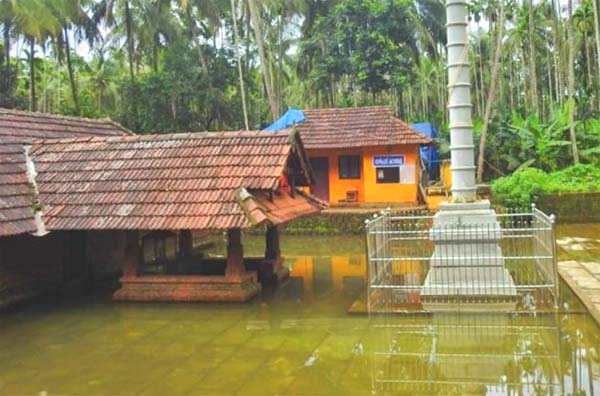

The main Shivling in the temple is always filled with water and one can only see it through the water only when there is good sunlight.
On Shivratri day, the water from the main sanctum sanctorum is drained out and one can have direct darshan of the Shivling on the day.
The main upa devatas worshipped in the temple are Thirumandham Kunnil Amma and Thiruvalayanadu Bhagavathy.
The five day annual festival in the temple begins on the Makam nakshatra day in Dhanu Masam (December – January) with tri kodiyettu (flag hoisting). The festival ends with Thiru Arattu on the fifth day.
Another important festival is observed on the Makam nakshatra day in Mithuna Masam (June – July). A three-day Kalam Pattu is held on the occasion. 1008 pot jala abhishekam or water offering is performed to the Goddesses worshipped in the temple during the occasion. This is also a rare temple in Kerala where devotees can perform jala abhishekam directly.
An important puja performed in the temple is Uma Maheshwara puja to solve all kinds of problems in marriage and for early marriage.
History
Over the passage of time, the temple fell into ruin.
Eventually, everything except the foundation of the sanctum sanctorum (Sreekovil),
the pedestal, the Shiva Linga, the foundation of the Namaskara Mandapam, and
the large sacrificial stone (Valiya Balikkallu) was buried under the earth.
In 1983, under the leadership of Shri Mancheri
Shivashankaran Master, the temple premises were cleared of forest growth, and
local residents resumed worship by lighting lamps. Following this, Retired
Captain R.C. Nair rendered 25 years of exemplary service, seeking only the
opportunity to serve the Lord as his reward.
In 2007, Shri N.N. Rajeevji Agasthyamala—whose life mission
is the social and spiritual upliftment of society through temple
restorations—visited the site upon invitation. Under his guidance, an Ashtamangalya
Swarnaprasnam (an astrological inquiry) was conducted in the presence of
experts. It was revealed that the presiding deity is a Swayambhu
Ardhanareeswara who resides eternally in water. It was advised that
reconstructing the temple to its former glory was essential for the prosperity
of the village.
Through the immense physical and financial dedication of
approximately 230 households in the village, the temple was rebuilt without
losing its ancient essence. Today, the complex features a copper-roofed Sreekovil,
a Namaskara Mandapam, the Thiruvalayanad Bhagavathi Temple, a Chuttambalam
(outer pavilion), a 32-foot monolithic stone flagstaff (Kodimaram), a Nagathara,
and an Agrashala (dining hall). Additionally, 62 cents of land were acquired
from private individuals to expand the temple grounds.
Unique Features
Deity in Water: The temple is one of the rarest in South
India where the Swayambhu Ardhanareeswara resides constantly in water. The
Shiva Linga is formed by two joined stones.
The Ritual Drain: Only on the day of Maha Shivaratri is the
water drained from the sanctum sanctorum to perform Abhishekam and special
pujas directly on the Shiva Linga.
Surrounded by Water: On all other days, the entire temple
structure—including the Sreekovil, Namaskara Mandapam, Sopanam, and Balikkallu—remains
surrounded by water.
The Monolithic Flagstaff: Unlike most temples, the flagstaff
here is carved from a single stone. Measuring 32 feet, it is the first granite Kodimaram
of its kind in Kerala.
Vettekkaran Presence: Lord Vettekkaran is worshipped as the
presiding deity (Paradevatha) beneath the temple well (Manikkinnar).
The Eternal Lamp: The Keda-vilakku (eternal lamp) in front
of the temple was lit by Shri Shri Shri Kesavananda Bharati of Edneer Mutt.
Major Festivals
1008 Kudam Jalabhishekam: Held on the Makham star in the
month of Mithunam. Devotees take a ritual dip in the temple pond, carry water
in pots (Kalasham), circumambulate the temple, and hand the water to the priest
who performs the bath from the open roof of the sanctum.
Thiruvathira (Dhanu): A special day where silk (Pattu) and
the sacred wedding thread (Thali) are offered to Lord Ardhanareeswara.
Maha Shivaratri: The only night when the water is drained
for an intimate Abhishekam inside the sanctum.
Annual Festival: Begins with the flag hoisting on Makham in
the month of Dhanu and concludes on the sixth day with the Aarattu (holy
bath).
Akhanda Nama Japam: A famous continuous chanting ritual held
for Lord Ayyappa during the Mandala season.
Important Offerings (Vazhipadu)
Uma-Maheshwara Puja: The primary offering for marriage
prospects and a long married life. It is held on the second Sunday of every
month (prior booking required).
Other Offerings: Sarvaiswarya Puja (for family prosperity),
offering of Silk and Thali, Muttarukkal, Dhara, Rakta Pushpanjali to the
Goddess, and Mangalya Sukta Pushpanjali.